
Answer
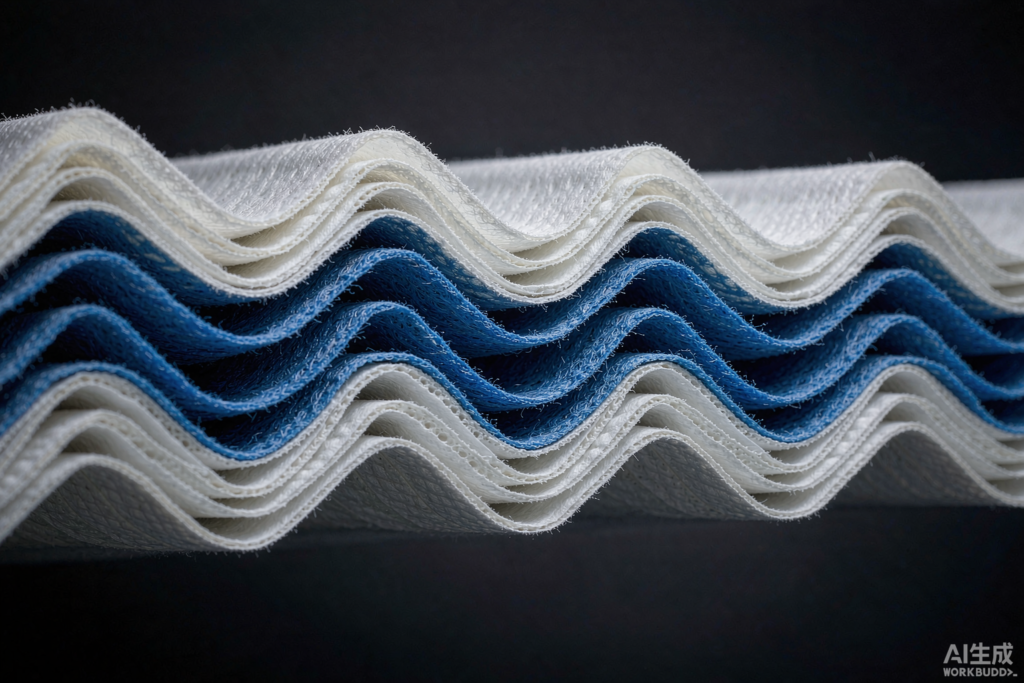
Filter media decides the core trade-off: capturing fine particles without starving flow. Cellulose is cheap and adequate for standard duty; synthetic captures finer at lower restriction; nanofiber adds a high-efficiency surface layer. For most importers, synthetic or nanofiber media delivers the best protection-to-flow balance. HW Filter specifies media by application, not price, across its automotive filter range.
Last updated: August 30, 2026
Every argument about filter quality eventually reduces to one question: what is the media made of? Housing design, pleat geometry and valve quality all matter, but media determines the fundamental trade-off every filter has to negotiate — capture particles finely enough to protect the engine, while letting fluid pass freely enough not to starve it.
This guide explains the four media families used in automotive filtration, the physics behind each, and how to choose between them for a specific application and market.
The trade-off that governs every media decision
Filtration performance is a three-way tension, and improving one axis usually costs you another:
- Efficiency — the percentage of particles of a given size the media captures, typically reported at 4, 10 or 20 µm for oil filters (ISO 4548-12) and by fractional efficiency for air (ISO 5011).
- Dust-holding capacity (DHC) — how much contaminant the media can accumulate before restriction becomes unacceptable. DHC drives service interval.
- Restriction (pressure drop) — the resistance the media imposes on flow. Too high, and oil bypasses through the relief valve or the engine breathes through a choked intake.
A media that captures very fine particles with a dense structure will restrict flow and clog quickly. A media that flows freely will pass particles that cause bearing wear. Media engineering is the art of moving all three numbers in the right direction at once — which is exactly what costs money.
Cellulose media
Cellulose (wood pulp) is the traditional workhorse, resin-impregnated and cured for wet strength. Fibres are relatively coarse and irregularly distributed, which produces a wide pore-size distribution.
| Property | Characteristic |
|---|---|
| Typical efficiency | Good at 20–30 µm; declining sharply below 10 µm |
| Dust-holding capacity | Moderate — surface loading dominates |
| Restriction | Low when clean; rises quickly as the surface loads |
| Cost | Lowest |
| Weakness | Swells with prolonged moisture exposure; loses wet strength if resin cure is inadequate |
Cellulose remains entirely appropriate for standard service intervals in passenger cars with conventional oil change schedules, and for price-sensitive aftermarket channels. Its failure mode is predictable: restriction climbs, and if the interval is respected the filter is replaced before that becomes a problem.
Synthetic media
Synthetic media uses polymer fibres — commonly polyester or polypropylene — produced by meltblown or spunbond processes. Fibre diameter is smaller and far more uniform than cellulose, which narrows the pore-size distribution.
Two consequences follow. First, efficiency at small particle sizes improves substantially without a proportional increase in restriction. Second, the media loads in depth rather than only at the surface, so dust-holding capacity rises — often two to three times that of comparable cellulose.
- Best for extended-drain intervals, turbocharged engines with tight bearing clearances, dusty operating environments, and heavy-duty applications where downtime is expensive.
- Cost materially higher than cellulose — typically the single largest cost line in a premium filter.
- Design note synthetic media is more sensitive to pleat spacing. Over-pleating to raise surface area can collapse pleats under flow and destroy the advantage you paid for.
Blended (cellulose-synthetic) media
Blended media adds a proportion of synthetic fibre — commonly 20–40 % — to a cellulose base. It is the pragmatic middle ground and, in practice, the most widely specified option for mainstream OEM-replacement filters.
The synthetic fraction fills the coarsest gaps in the cellulose pore distribution, which lifts fine-particle efficiency and improves depth loading, while the cellulose base keeps cost controlled. For most passenger-car programmes with normal or moderately extended service intervals, a well-engineered blend delivers most of the synthetic benefit at a fraction of the price premium.
When comparing quotations, blend ratio is one of the specification lines most often left vague. Ask for the ratio explicitly, and ask for the basis weight — two “blended” media with identical marketing language can differ by 30 % in performance.
Nanofiber-layered media
Nanofiber media is not a separate base material but a treatment: an extremely fine electrospun fibre layer, typically well under one micron in diameter, applied on top of a cellulose or synthetic substrate.
Because the nanofiber layer sits on the surface, it captures fine particles through interception and inertial impaction without adding significant depth resistance. The result is high fractional efficiency at small particle sizes with a modest restriction penalty — the combination that engine air filtration in high-dust markets has been asking for.
- Strength excellent fine-particle capture with comparatively low pressure drop; the substrate still provides depth capacity.
- Limitation the surface layer is mechanically delicate. Pleating, handling and assembly must be controlled, or the layer is damaged before the filter ever reaches a vehicle.
- Where it earns its cost engine air filters in dusty regions, and cabin filtration where fine particulate capture is the point.
Cabin air filtration is a different problem
Cabin filters do not protect machinery; they protect people. That changes the target from wear particles to respirable particulate, pollen, and in the case of combination filters, gaseous pollutants.
| Cabin filter type | Captures | Typical use |
|---|---|---|
| Particle (pleated synthetic) | Dust, pollen, coarse particulate | Baseline replacement |
| Activated carbon combination | Particulate plus odours, NOx, SOx, VOCs by adsorption | Urban and traffic-heavy markets |
| High-efficiency multi-layer | Fine particulate approaching HEPA-class fractional efficiency | Premium and EV segments |
Carbon loading is the specification to interrogate here. Adsorption capacity depends on the mass and quality of activated carbon, and a thin decorative carbon layer behaves nothing like a properly loaded one. For selection detail, see our cabin air filter selection guide.
Matching media to application
| Application | Recommended media | Reasoning |
|---|---|---|
| Standard passenger-car oil filter, normal interval | Cellulose or light blend | Cost-effective; interval respected before restriction matters |
| Turbocharged engine, extended drain | Synthetic or high-ratio blend | Fine-particle efficiency plus DHC over a long interval |
| Engine air filter, high-dust market | Nanofiber-layered | Fine capture without choking intake flow |
| Diesel fuel filtration | Multi-layer synthetic with coalescing stage | Water separation is as critical as particulate removal |
| Heavy-duty truck, long service interval | Full synthetic | DHC and uptime outweigh unit cost |
| Cabin air, urban market | Carbon combination | Gaseous pollutants and odour, not just particulate |
What to write into a specification
Media described only as “high quality filter paper” is not a specification. A useful one names:
- Media family and, for blends, the synthetic ratio
- Basis weight (g/m²) and, where relevant, thickness
- Target efficiency at a stated particle size, referencing a test standard
- Dust-holding capacity at a defined terminal pressure drop
- Initial restriction at rated flow
- For carbon cabin filters, carbon loading per unit area
Those six lines change the conversation from marketing adjectives to comparable numbers — and they make lot-to-lot consistency auditable, which is where most quality disputes actually begin.
Frequently asked questions
Is synthetic media always better than cellulose?
No. Synthetic media offers higher efficiency and dust-holding capacity, but if the service interval is short and the environment is clean, that capacity is never used and the buyer pays for headroom that delivers nothing. Match media to interval and operating environment, not to marketing tiers.
What does a blend ratio actually change?
The synthetic fraction narrows the pore-size distribution of the cellulose base, improving fine-particle capture and shifting the filter from pure surface loading toward depth loading. Higher synthetic content generally means better efficiency and capacity at higher cost.
Can nanofiber media be used in oil filters?
It can, but the economics usually favour air and cabin applications. Oil filtration operates at higher pressure and viscosity, where robust depth media handles the duty cycle more reliably than a delicate surface layer.
Why do two filters with the same claimed efficiency perform differently?
Because efficiency is only one of three variables. Differences in dust-holding capacity, pleat geometry, effective media area and lot-to-lot basis-weight consistency all change real-world behaviour. Two filters can share a headline efficiency number and diverge sharply over a service interval.
How do I verify the media I specified is what was delivered?
Request incoming inspection records for the media lot, not only the media data sheet, and hold retained samples from the first production lot as a reference baseline for later comparison.
Next steps
Media choice should follow from the application, not from a price tier. If you are specifying a programme, browse the range across oil, air, fuel and cabin air filters, review how to qualify a manufacturer, or send your target platforms and interval requirements for a media recommendation.
Frequently Asked Questions
What filter types does HW Filter manufacture?
HW Filter (Chuzhou HW Filter Technology Co., Ltd.) produces oil, air, fuel, cabin, transmission, motorcycle and heavy-duty truck filters, plus bump stops / jounce bumpers. Products are available as both OEM and ODM / private-label.
Do you support OEM and ODM / private-label production?
Yes. We offer OEM (build to your specification) and ODM / private-label (custom branding, packaging and tooling). MOQ and tooling requirements depend on the product and customization level.
Can you cross-reference OEM part numbers to your filters?
Yes. Send us the exact OE part number and we match it to a compatible HW Filter replacement and confirm fitment before you place an order.
What quality standards do your filters meet?
Our filters are built to common automotive standards such as ISO 4548 for full-flow oil filters and SAE J905 / J806 for filter media and performance, with batch testing and QC documentation.
What are your typical lead times and MOQ?
Standard items ship faster; customized or private-label runs need tooling and a longer lead time. Exact MOQ and lead time are quoted per inquiry based on product and order volume.
Do you provide export documentation and worldwide shipping?
Yes. We supply full export documentation (commercial invoice, packing list, certificate of origin where needed) and ship worldwide to distributors, workshops and private-label brands.