
Answer
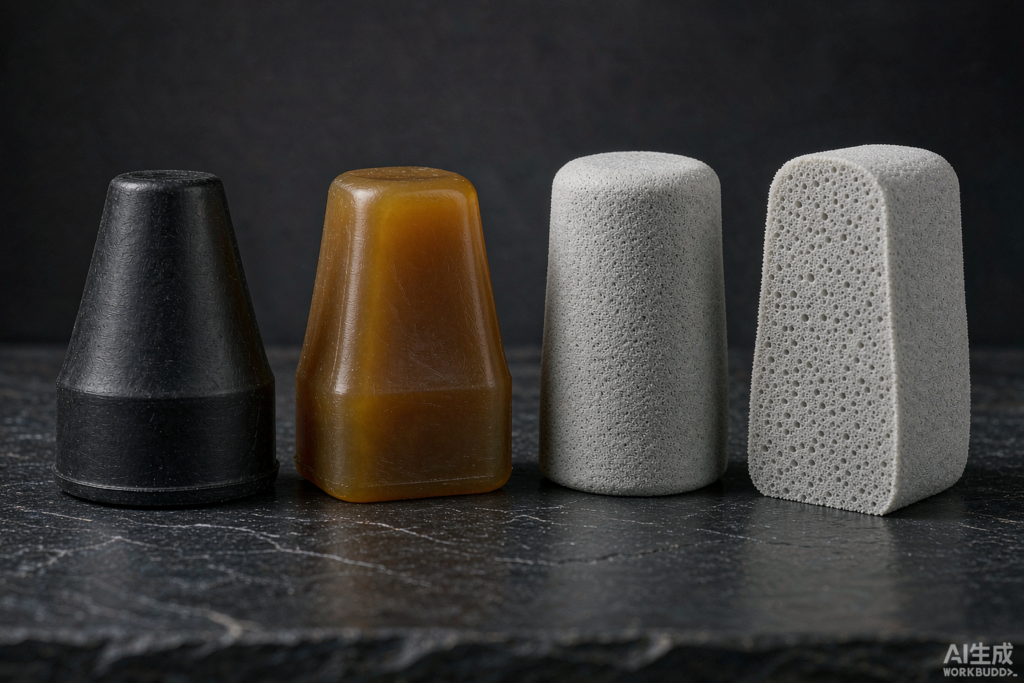
A bump stop, properly the jounce bumper, is a tuned spring element that shapes ride and handling through much of normal suspension travel, not just at full compression. Rubber is durable and progressive; polyurethane is firmer and longer-lived; microcellular foam is lightweight and highly tunable. Choose by vehicle duty and desired feel. HW Filter supplies rubber, PU, and foam bump stops for passenger, truck, and performance use.
Last updated: August 30, 2026
Ask a workshop what a bump stop does and the usual answer is “it stops the suspension hitting the chassis”. That is true, and it badly understates the part. On a modern vehicle the bump stop — properly, the jounce bumper — is a tuned spring element that participates in ride and handling across a large portion of normal suspension travel, not only at the end of it.
Which is why fitting the wrong one changes how a vehicle rides long before anything ever bottoms out. This guide covers what jounce bumpers do, how the three main material families differ, failure modes, and what to specify when sourcing.
From crash stop to tuned spring element
Early bump stops were simple rubber blocks doing exactly what the name suggests. Contemporary suspension design uses them differently: the bumper engages progressively during the upper portion of travel and adds a rising, non-linear spring rate on top of the main coil.
That progressive engagement lets engineers do something otherwise impossible — use a relatively soft main spring for ride comfort while retaining enough total rate to control body movement under load, cornering and large inputs. The main spring handles small and medium inputs; the bumper contributes increasingly as travel builds.
Three consequences matter for anyone buying or replacing these parts:
- Height and profile are calibration data, not packaging. A bumper 10 mm shorter engages later and changes effective spring rate through the range where it engages.
- Material stiffness is part of the tune. Substituting a stiffer material at the same height produces a harsher ride even though the part “fits”.
- Wear degrades ride quality gradually. A deteriorated bumper does not usually announce itself; the vehicle simply rides and handles worse than it did.
The three material families
Natural and synthetic rubber
Conventional moulded rubber remains widely used, particularly as OEM-equivalent replacement for older platforms.
- Strengths low cost, mature moulding process, good damping characteristics.
- Weaknesses compression set over time — the part gradually loses free height and never fully recovers; degradation from ozone, UV and oil exposure; performance shift at temperature extremes.
- Typical service reality visible cracking and crumbling on higher-mileage vehicles, especially in hot climates.
Polyurethane (PU)
Cast polyurethane offers substantially better mechanical properties, which is why it has displaced rubber in many applications.
- Strengths higher tear and abrasion resistance, better oil and ozone resistance, much lower compression set, and a wide achievable hardness range through formulation.
- Weaknesses higher cost; sensitive to hydrolysis in prolonged wet conditions unless correctly formulated; requires tighter process control.
- Where it earns its cost commercial vehicles, load-carrying applications, and any duty cycle with frequent large suspension inputs.
Microcellular polyurethane (MCU)
Microcellular PU — a closed-cell foamed polyurethane — is the current reference for OEM jounce bumpers on many passenger platforms.
The closed-cell structure produces a genuinely progressive force-deflection curve: soft initial engagement that stiffens smoothly as cells compress, with high energy absorption and excellent recovery. It also weighs considerably less than solid rubber, which matters as unsprung mass.
- Strengths progressive rate, high energy absorption, low compression set, light weight, long service life.
- Weaknesses highest unit cost; requires controlled moulding, since cell structure consistency determines performance.
- Sourcing note MCU quality varies more between suppliers than solid materials, because it depends on process control rather than only on formulation. Density and cell structure consistency are the specification lines that matter.
Material comparison
| Property | Rubber | Polyurethane | Microcellular PU |
|---|---|---|---|
| Compression set resistance | Moderate | Good | Excellent |
| Progressive rate character | Limited | Moderate | Excellent |
| Energy absorption | Moderate | Good | Excellent |
| Oil and ozone resistance | Fair | Good | Good |
| Weight | Highest | High | Lowest |
| Relative cost | Low | Medium | High |
| Typical application | Aftermarket replacement, older platforms | Commercial and load-carrying | OEM passenger-car jounce bumpers |
Failure modes and how they present
Jounce bumper deterioration is rarely diagnosed directly, because the symptoms are attributed elsewhere.
- Compression set — the part has permanently lost height, so it engages later. The vehicle feels floaty and may bottom out harshly on inputs it previously absorbed.
- Cracking and disintegration — ozone, UV and oil attack on aged rubber. Fragments may be found in the wheel arch; the remaining stub gives a sudden, hard engagement.
- Bonding or retention failure — the bumper separates from its cup or dislodges from its mount, producing intermittent noise that mimics a worn strut mount.
- Hydrolysis (PU, wet climates) — surface becomes soft and tacky; mechanical properties fall well below specification.
- Wrong part fitted — the most common failure of all. Correct diameter, wrong free height. Everything bolts up and the ride is subtly wrong.
A practical inspection habit: whenever struts or shock absorbers are replaced, inspect the jounce bumper and dust boot as a matter of course. They are already accessible at that point, the parts are inexpensive relative to the labour, and a fresh strut paired with a collapsed bumper will not deliver the ride the customer expects.
What to specify when sourcing
Because these parts look simple, specifications are often written loosely and quality problems arrive later.
- Material family and formulation — rubber, solid PU or microcellular PU. For MCU, specify target density.
- Free height and outside diameter with tolerances — free height is the calibration-critical dimension.
- Hardness — Shore A for rubber and solid PU; density and force-deflection for MCU, since Shore hardness poorly describes foamed materials.
- Force-deflection curve — the single most informative document a supplier can provide, and the one that reveals whether the part will replicate OEM ride behaviour.
- Compression set test data — percentage set after a defined load, temperature and duration.
- Ageing and environmental resistance — ozone, UV and where relevant hydrolysis resistance for the target market climate.
- Mount interface detail — cup dimensions, retention feature and, where applicable, integration with the dust boot assembly.
If a supplier can produce a force-deflection curve and compression set data on request, they are engineering the part. If they can only quote a Shore hardness and a price, they are moulding to a drawing someone else supplied.
Frequently asked questions
Do bump stops only work at the end of suspension travel?
No. On modern platforms the jounce bumper engages progressively through the upper portion of travel and contributes to spring rate during normal driving. It is a tuned suspension element, not merely a limit stop.
Can I fit a taller or stiffer bump stop to reduce bottoming out?
It will reduce bottoming out and it will also change ride quality, because engagement point and effective rate are part of the suspension calibration. If the vehicle bottoms out under normal load, the more likely causes are tired springs, worn dampers or a collapsed bumper — diagnose those before altering the calibration.
Is polyurethane always better than rubber?
For durability, generally yes — better compression set resistance and better oil and ozone resistance. But “better material” is not the same as “correct part”. A PU bumper at the wrong free height or hardness will ride worse than a correct rubber one.
How do I know when a jounce bumper needs replacing?
Inspect for cracking, crumbling, permanent height loss against a new reference part, softness or tackiness, and separation from the mount cup. Because degradation is gradual, comparison against a new part is more reliable than judging condition in isolation.
What single document best predicts sourcing quality?
The force-deflection curve. It shows whether the part reproduces the intended progressive rate, which is what determines ride behaviour — dimensions and hardness alone do not.
Next steps
Jounce bumpers are inexpensive parts with disproportionate influence on ride quality, which makes specification accuracy the whole game. Explore the bump stop and jounce bumper range, see the full product line, review how to qualify a manufacturer, or send your OEM references and target platforms for a matched quotation with dimensional data.
Frequently Asked Questions
What filter types does HW Filter manufacture?
HW Filter (Chuzhou HW Filter Technology Co., Ltd.) produces oil, air, fuel, cabin, transmission, motorcycle and heavy-duty truck filters, plus bump stops / jounce bumpers. Products are available as both OEM and ODM / private-label.
Do you support OEM and ODM / private-label production?
Yes. We offer OEM (build to your specification) and ODM / private-label (custom branding, packaging and tooling). MOQ and tooling requirements depend on the product and customization level.
Can you cross-reference OEM part numbers to your filters?
Yes. Send us the exact OE part number and we match it to a compatible HW Filter replacement and confirm fitment before you place an order.
What quality standards do your filters meet?
Our filters are built to common automotive standards such as ISO 4548 for full-flow oil filters and SAE J905 / J806 for filter media and performance, with batch testing and QC documentation.
What are your typical lead times and MOQ?
Standard items ship faster; customized or private-label runs need tooling and a longer lead time. Exact MOQ and lead time are quoted per inquiry based on product and order volume.
Do you provide export documentation and worldwide shipping?
Yes. We supply full export documentation (commercial invoice, packing list, certificate of origin where needed) and ship worldwide to distributors, workshops and private-label brands.