
Answer
Automotive filtration moved from a routine service part to a board-level issue in 2026, driven by tighter emissions law (Euro 7), rapid EV adoption, and rising demand for clean cabin air. Oil-filter demand softens in pure EVs while cabin and thermal-management filtration grows. Importers should rebalance their mix toward cabin, HEPA/activated-carbon, and EV-compatible filtration while keeping combustion-filter coverage.
Last updated: August 30, 2026
Why Filtration Is Suddenly a Board-Level Topic
The automotive filter has always been a quiet, low-cost, replace-on-schedule part. That is changing fast. Three forces — tighter emissions law, the rapid spread of electric vehicles, and a global jump in concern about the air people breathe inside the cabin — are rewriting what “a good filter” actually means. For distributors, fleet operators, and importers, these shifts are no longer background noise: they directly affect regulatory compliance, warranty risk, and total cost of ownership (TCO).
The Market in Numbers
Despite the EV transition, the global automotive filter market is still growing. Independent analyst consensus puts the market at roughly US$17–18 billion in 2026, on track to reach US$25–36 billion by 2030–2033 at a 4.8–5.7% CAGR. Two structural facts matter most for buyers:
- The aftermarket is the engine of demand. Replacement sales already account for roughly 70–78% of the market. A large, aging global vehicle parc (OICA counts 1.4–1.5 billion vehicles in use) means a steady, decade-plus stream of filter replacements per vehicle.
- Cabin air is the fastest-growing segment. Cabin filters are climbing at a ~6.8% CAGR, projected to reach about US$9.3 billion by 2033, far outpacing oil and fuel categories.
Euro 7 and the PN10 Shock
The European Union’s Euro 7 regulation (Regulation (EU) 2024/1257) is the single biggest technical driver for engine filtration. Its key change: the solid particle-number limit drops from PN23 (23 nanometres) to PN10 (10 nanometres), phasing in from 29 November 2026 for new car and van type approvals, extending to heavy vehicles through 2028–2029.
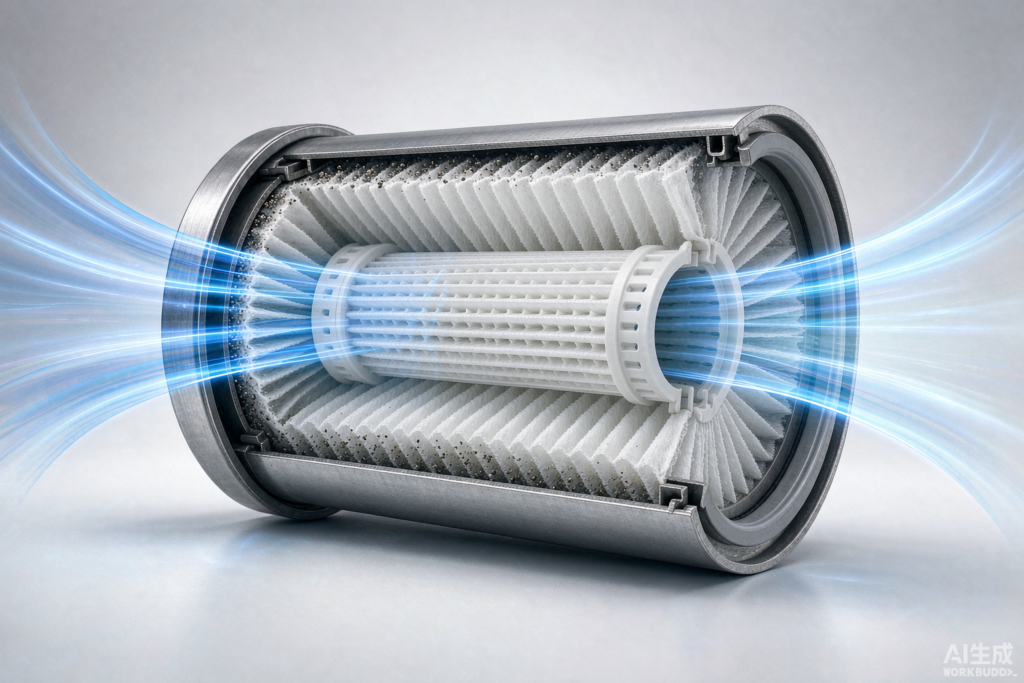
Sub-micron particles move by random Brownian motion and slip straight through conventional cellulose paper. To trap them without choking airflow, major OEMs and filter makers (Mann+Hummel, Donaldson, Freudenberg) are accelerating electrospun nanofiber composite media — an ultra-thin polymer web (100–300 nm fibers) layered on a cellulose or synthetic base. It captures soot and dust at the surface, preventing premature clogging and protecting sensitive parts like Mass Air Flow (MAF) sensors and high-pressure common-rail (HPCR) fuel injectors.
Euro 7 also, for the first time, regulates non-exhaust emissions — brake and tire wear particles — and extends the “duration of conformity” to 200,000 km or 10 years (doubling Euro 6). Filters and emission hardware must now stay effective for the vehicle’s whole life, not just its first 100,000 km.
The EV Paradox: Fewer Filters, Cleaner Cabins
Electric vehicles need no oil filter, no fuel filter, and no combustion air filter. As EV share rises (some forecasts see 28% of new sales by 2034), the addressable market for traditional engine filters contracts — by an estimated 22–28% through 2034 versus a no-shift scenario.
But EVs keep their full HVAC system. That makes the cabin air filter the only filter category that grows with EV penetration. Premium EVs are pushing cabin filtration harder than any combustion car ever did: HEPA-grade media capturing 99.97% of particles at 0.3 µm, often paired with activated carbon for gases and odor. Tesla’s “Bioweapon Defense Mode” and Hyundai’s sensor-driven cabin air systems are examples. EV cabin filters also demand 30–50% more media surface area than ICE equivalents.
A new niche is also emerging: battery thermal-management and coolant-loop filters (ceramic-coated, flame-retardant media rated for ~40,000 km service). This segment was worth roughly US$480 million in 2026 and is expected to double as EV sales climb.
Cabin Air: The Quiet Boom
Cabin filtration is growing because the problem is real and visible. The WHO documents urban PM2.5 exceeding safe limits across Asia and the Middle East. Wildfire smoke (western US, southern Europe, parts of Southeast Asia), pollen seasons, and post-pandemic awareness of airborne viruses have turned cabin air from a comfort feature into a health expectation.
Regulation is catching up: China’s GB/T 28382-2022 already mandates EV cabin filters with PM2.5 removal above 90%. Buyers in these markets increasingly specify multi-layer combinations — particulate media + activated carbon + (optionally) antibacterial treatment — rather than a single paper element.
Smart and Sustainable Media
Two more trends are reaching the spec sheet:
- Connected filtration. IoT-enabled housings embed pressure and particle-count sensors that feed data to the vehicle ECU, enabling predictive replacement only when thresholds are breached. Adoption already exceeds 10% in premium segments and is growing fastest in North America, where distributors link sensor data to cloud service platforms. The premium is modest (~US$2–3 per filter).
- Circular materials. Biodegradable PLA media, recyclable composite housings, and washable/reusable elements are moving from concept to catalog, driven by EU circular-economy mandates and corporate ESG targets.
What This Means for B2B Buyers: A Spec Checklist
For importers and fleet procurement, the takeaway is practical. When specifying or sourcing replacement filters in 2026, verify:
- Fractional efficiency, not just nominal microns. Ask for ISO 5011 fractional separation data, especially capture of sub-micron (PN10-class) particles. Surface-loading nanofiber or synthetic media maintains stable differential pressure over longer intervals.
- Media type by duty cycle. Synthetic and nanofiber composites suit harsh, high-dust, or Euro 7-exposed fleets; cellulose remains cost-effective for light-duty, low-interval use.
- Cabin specification. For urban, allergy, or EV fleets, specify HEPA-grade + activated carbon, and confirm PM2.5 removal rates where local regulation demands it.
- Compatibility and OEM cross-reference. A verified OE-cross matrix reduces misapplication risk that can damage MAF sensors or injectors — the most expensive “savings” a buyer can make.
- Supply resilience. With Asian capacity expanding ~35% since 2022 and exports growing ~19% annually, dual-sourcing and short lead times are realistic, but audit ISO 9001 / IATF 16949 discipline before committing volume.
Closing: Filtration as a Partnership
The filter is no longer a commodity line item. Euro 7, electrification, and cabin-air health have turned it into a component that protects compliance, uptime, and brand reputation. Buyers who specify on fractional efficiency, media science, and verified cross-references will lower TCO and avoid warranty exposure — while those who buy on price alone inherit the risk.
At HW filter (HW Filter Technology Co., Ltd.), we manufacture oil, air, fuel, and cabin filters with synthetic and nanofiber composite media, HEPA-grade cabin options, and a verified OE-cross reference library for global fleets. Whether you are building an EV cabin-air program or upgrading a Euro 7-exposed diesel fleet, the right media specification is the difference between a filter that merely fits and one that performs. Talk to our team about sampling and OEM/ODM programs.
Frequently Asked Questions
What filter types does HW Filter manufacture?
HW Filter (Chuzhou HW Filter Technology Co., Ltd.) produces oil, air, fuel, cabin, transmission, motorcycle and heavy-duty truck filters, plus bump stops / jounce bumpers. Products are available as both OEM and ODM / private-label.
Do you support OEM and ODM / private-label production?
Yes. We offer OEM (build to your specification) and ODM / private-label (custom branding, packaging and tooling). MOQ and tooling requirements depend on the product and customization level.
Can you cross-reference OEM part numbers to your filters?
Yes. Send us the exact OE part number and we match it to a compatible HW Filter replacement and confirm fitment before you place an order.
What quality standards do your filters meet?
Our filters are built to common automotive standards such as ISO 4548 for full-flow oil filters and SAE J905 / J806 for filter media and performance, with batch testing and QC documentation.
What are your typical lead times and MOQ?
Standard items ship faster; customized or private-label runs need tooling and a longer lead time. Exact MOQ and lead time are quoted per inquiry based on product and order volume.
Do you provide export documentation and worldwide shipping?
Yes. We supply full export documentation (commercial invoice, packing list, certificate of origin where needed) and ship worldwide to distributors, workshops and private-label brands.