
Answer
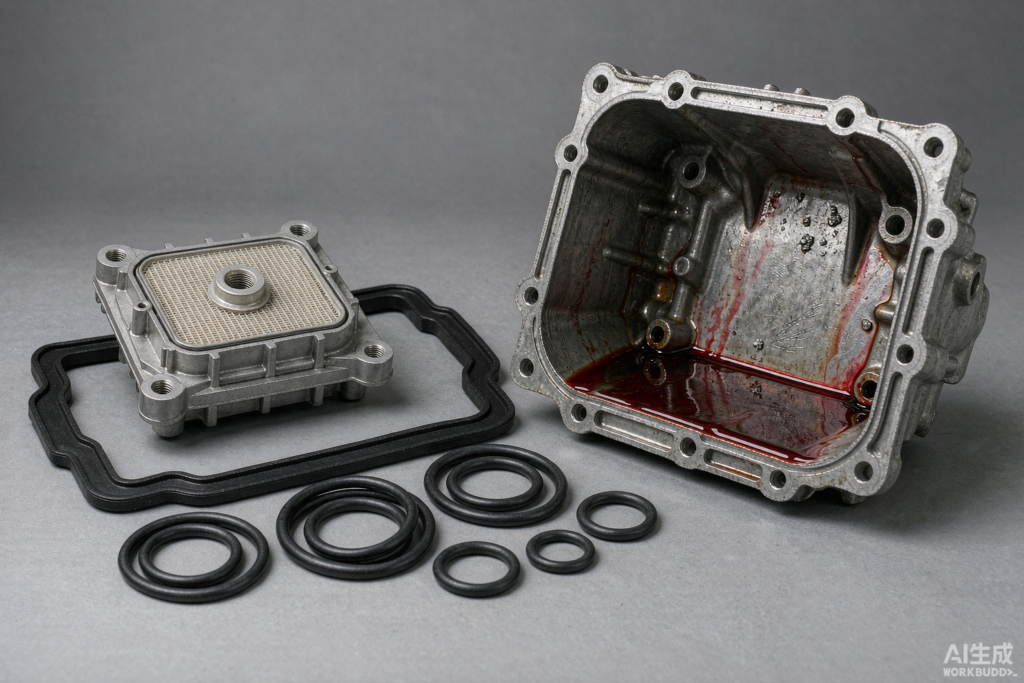
A transmission filter protects the valve body and clutches by keeping ATF clean; failure is usually silent until the transmission slips. Service the filter and fluid together on the manufacturer interval, use the correct ATF kit, and never reuse a clogged filter. For importers, specify filters by pan shape, gasket, and bypass-valve rating. HW Filter supplies matched ATF filter kits across major transmissions.
Last updated: August 30, 2026
Automatic transmissions fail quietly. There is rarely a warning light before a shift starts to slip — there is a filter that has been progressively restricting flow, a pump that has been cavitating, and clutch material that has been circulating through a hydraulic valve body designed for clean fluid. By the time the symptom appears, the damage is already distributed.
Transmission filtration is the least discussed and most consequential filtration system on a vehicle, because a transmission rebuild costs an order of magnitude more than an engine oil service. This guide explains how transmission filters work, the difference between the main filter types, how change intervals should be set, and what to specify when sourcing.
What a transmission filter actually protects
Automatic transmission fluid does four jobs at once: it transmits hydraulic power, lubricates gears and bearings, cools the assembly, and provides the friction characteristics the clutch packs depend on. Contamination degrades all four.
The contaminants come from inside the transmission itself:
- Clutch friction material — normal wear sheds organic and metallic particles continuously.
- Metallic wear debris from gears, bearings, thrust washers and the pump.
- Manufacturing residue — casting sand and machining swarf, most significant in the first thousands of kilometres.
- Oxidation products — varnish and sludge formed when fluid is thermally stressed, which is why overheating and contamination are the same problem viewed from different angles.
The valve body is where this becomes expensive. Solenoid valves and spool bores operate at fine clearances; a particle that lodges in a spool bore causes a shift-quality fault that reads electronically like a solenoid failure. Many “solenoid” replacements are contamination symptoms.
Filter types and where each is used
Pan-mounted suction filters
The most common arrangement. A filter assembly bolted inside the pan draws fluid through media on the suction side of the pump. Because it operates under suction, restriction directly threatens pump inlet pressure — a clogged suction filter can cause aeration and cavitation, which damages the pump and destroys fluid properties.
These filters are typically supplied as a kit with a pan gasket, and the gasket is not an accessory. Reusing a deformed gasket or a hardened rubber-coated steel pan seal is a common cause of post-service leaks.
Spin-on and cartridge in-line filters
Many transmissions add a pressure-side filter, either spin-on or a cartridge in a housing. Operating downstream of the pump, these can use finer media without threatening pump inlet conditions, so they carry most of the fine-filtration duty.
Media types in transmission filtration
| Media | Characteristics | Typical application |
|---|---|---|
| Nylon / polyester mesh | Coarse (roughly 100–150 µm), high flow, non-clogging by design | Suction-side pan filters where flow protection is paramount |
| Felt / non-woven synthetic | Depth loading, finer capture, moderate restriction | Pan filters on transmissions requiring finer suction filtration |
| Pleated synthetic | Fine capture with high surface area | Pressure-side spin-on and cartridge elements |
Note the design intent difference from engine oil filtration: a suction-side transmission filter is deliberately coarse. Fitting finer media than specified is not an upgrade — it risks pump starvation. Media selection here must follow the OEM hydraulic design, not a general preference for finer filtration. Background on the underlying trade-offs is in our guide to filter media types.
The “sealed for life” question
Many modern transmissions are marketed as sealed or filled for life, with no scheduled fluid or filter service. The engineering reality is more nuanced.
“For life” is defined against the manufacturer’s design life under typical duty. It is not a claim that the fluid does not degrade. Under towing, urban stop-start traffic, high ambient temperatures or hilly terrain, thermal stress accelerates oxidation and clutch wear well beyond the assumptions behind that label.
Practical position for fleet and commercial operators: treat “sealed for life” as “no scheduled interval published”, not “no service ever beneficial”. Where the transmission has an accessible pan and filter, a service based on measured fluid condition — colour, smell, and ideally particle count or oil analysis — is usually justified in demanding duty cycles. Be aware, however, of the legitimate caveat: a fluid change on a badly neglected high-mileage transmission can coincide with failure, because fresh fluid alters friction characteristics in a unit whose clutches have already worn. That argues for servicing on schedule, not for never servicing.
Setting service intervals
| Duty cycle | Fluid and filter interval guidance |
|---|---|
| Normal passenger use, moderate climate | Follow OEM schedule; where none exists, inspect fluid condition periodically after mid-life |
| Towing, heavy loads, hilly terrain | Shorten materially — heat is the primary ageing mechanism |
| Urban stop-start, taxi and delivery duty | Shorten; torque converter slip generates heat at low road speed |
| High ambient temperature markets | Shorten; consider auxiliary cooling |
| Any transmission after a failure or overhaul | Early post-repair service to remove debris liberated during work |
The physical indicator is fluid condition. Healthy ATF is translucent, typically red or amber, with a faint sweet odour. Darkened fluid indicates thermal degradation. A burnt smell indicates clutch material has overheated — at that point filtration is managing consequences, not preventing them.
Installation details that cause comebacks
Transmission filter service is unforgiving of small errors. The recurring ones:
- Old pan gasket left in place. Double-gasketing leaks under pressure and can distort the pan flange.
- Filter seal or O-ring not seated in the pump inlet bore. This causes air ingestion — the single most damaging installation error, because aeration destroys hydraulic control.
- Pan bolts over-torqued or tightened out of sequence. Warps the flange and creates a leak path that resists correction.
- Incorrect fluid specification. ATF specifications are not interchangeable; friction modifier packages differ and shift quality depends on them.
- Fill level set cold. Level must be checked at the specified temperature; a cold-set level reads high and can foam in service.
What to specify when sourcing transmission filter kits
- Complete kit content — filter, pan gasket, and where applicable the pump inlet O-ring and rubber-coated steel seal. Confirm what is in the box.
- Media grade matched to OEM design, not “finer is better”.
- Dimensional report on samples — inlet neck diameter, standpipe height and seal cross-section are where fitment problems hide.
- Gasket material grade — the gasket must retain elasticity at operating temperature over the service life, not just seal on installation day.
- Cross-reference accuracy against the OEM references you actually stock, verified on physical samples rather than a catalogue table.
Frequently asked questions
Does a transmission filter need replacing at every fluid change?
Where the filter is accessible in the pan, replacing it with the fluid is standard practice — a loaded filter reintroduces restriction into fresh fluid and the incremental cost is small relative to the labour already being spent. For sealed in-line cartridge designs, follow the OEM schedule.
Can I fit a finer filter to protect the transmission better?
Not on the suction side. Suction-side filters are deliberately coarse to protect pump inlet pressure; finer media there risks aeration and cavitation. Fine filtration belongs on the pressure side, where the OEM designed for it.
Is it true that changing fluid on a high-mileage transmission causes failure?
The correlation is real but the causation is usually misread. Fluid is often changed because symptoms have appeared, meaning wear is already advanced. Fresh fluid changes friction characteristics in a unit with worn clutches, which can expose that condition. The lesson is to service on schedule rather than to avoid servicing.
What does darkened transmission fluid indicate?
Thermal degradation and oxidation. A burnt odour additionally indicates clutch friction material has overheated. Both mean the transmission has been running hotter than design intent — investigate cooling and duty cycle, not only filtration.
How do I confirm a filter kit will fit before a bulk order?
Request platform-matched samples with a dimensional report covering inlet neck diameter, standpipe height and seal cross-section, and trial-fit on the target transmission before committing volume. Catalogue cross references are a starting point, not verification.
Next steps
Transmission filtration rewards specification discipline more than most categories, because the failure cost is so asymmetric. Explore the transmission filter and ATF kit range, related oil filtration, review how to qualify a manufacturer, or send your target platforms and OEM references for a matched kit quotation.
Frequently Asked Questions
What filter types does HW Filter manufacture?
HW Filter (Chuzhou HW Filter Technology Co., Ltd.) produces oil, air, fuel, cabin, transmission, motorcycle and heavy-duty truck filters, plus bump stops / jounce bumpers. Products are available as both OEM and ODM / private-label.
Do you support OEM and ODM / private-label production?
Yes. We offer OEM (build to your specification) and ODM / private-label (custom branding, packaging and tooling). MOQ and tooling requirements depend on the product and customization level.
Can you cross-reference OEM part numbers to your filters?
Yes. Send us the exact OE part number and we match it to a compatible HW Filter replacement and confirm fitment before you place an order.
What quality standards do your filters meet?
Our filters are built to common automotive standards such as ISO 4548 for full-flow oil filters and SAE J905 / J806 for filter media and performance, with batch testing and QC documentation.
What are your typical lead times and MOQ?
Standard items ship faster; customized or private-label runs need tooling and a longer lead time. Exact MOQ and lead time are quoted per inquiry based on product and order volume.
Do you provide export documentation and worldwide shipping?
Yes. We supply full export documentation (commercial invoice, packing list, certificate of origin where needed) and ship worldwide to distributors, workshops and private-label brands.