
Answer
A reliable automotive filter supplier protects your customers’ engines and your brand. Cover air, oil, fuel, and cabin plus bump stops and transmission filters, and qualify the supplier on media, testing, certifications, MOQ, and lead time. HW Filter (Chuzhou HW Filter Technology Co., Ltd.) manufactures automotive filters with OEM and ODM/private-label support, cross-reference, samples, and export documentation.
Last updated: September 11, 2026
Auto Filter Cross Reference Master Guide
A single auto filter cross reference master method works for every filter family — oil, air, fuel and cabin. This guide gives distributors and buyers one repeatable process, explains OEM vs aftermarket vs OEM-equivalent, and shows how to build a cross-reference database you can quote from with confidence.
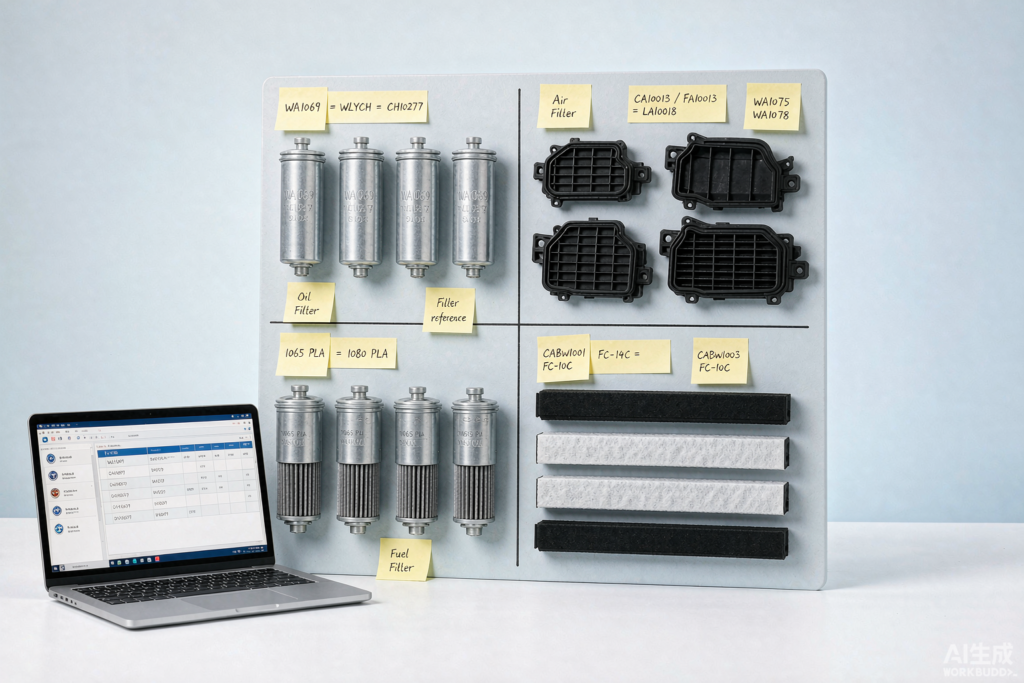
The Four Filter Families You’ll Cross-Reference
- Oil filter — spin-on or cartridge; matched by thread, gasket and bypass spec.
- Air filter — panel, cylindrical or conical; matched by dimensions and shape.
- Fuel filter — inline, spin-on or cartridge; diesel adds water separation.
- Cabin filter — panel; matched by dimensions and media (particulate, carbon, HEPA).
OEM vs Aftermarket vs OEM-Equivalent
- OE — the part originally fitted by the vehicle maker.
- Aftermarket (branded) — Mann, Mahle, Bosch, Fram, etc.; own part numbers mapping to the OE.
- OEM-equivalent — made by a filter manufacturer to the same specification, unbranded or private-label, at a lower landed cost.
For importers, OEM-equivalent from a single manufacturer is usually the best margin play — same performance, one database, one quality system.
The Cross-Reference Method (Works for Any Filter)
- Capture the OE number from the old part or the vehicle build sheet.
- Identify the application — make, model, engine code, year.
- Match dimensions precisely — length, width, height, thread, gasket, flange.
- Validate media and grade for the duty (dusty? diesel? cabin HEPA?).
- Confirm with the manufacturer’s database — never quote on an unverified list.
Building a Cross-Reference Database
Keep one spreadsheet with these columns so any salesperson can cross any filter:
| Column | Purpose |
|---|---|
| OE Number | Source of truth |
| Application | Make / model / engine / year |
| Family | Oil / Air / Fuel / Cabin |
| Dimensions | Physical match |
| HW Number | Your equivalent SKU |
| Media / Grade | Duty match |
Maintain it quarterly, or on every new OE release from your target markets.
Master Sample (All Four Families)
| Family | OE Example | Application | HW Equivalent |
|---|---|---|---|
| Oil | 90915-10001 | Toyota 1NZ | HW-OF-101 |
| Air | 17801-0D040 | Toyota Yaris | HW-AF-1040 |
| Fuel | 23390-0L010 | Hilux D-4D | HW-FF-610 |
| Cabin | 87139-0D040 | Toyota | HW-CF-104 |
Link the families together: our oil filter cross reference and air filter cross reference drill into two of these in detail.
Why Source OEM-Equivalent from One Manufacturer
A single supplier gives you one verified database, consistent media quality under an IATF 16949 system, and one relationship to manage for samples, tooling and private label. It also removes the “which cross list is right” ambiguity that causes returns.
Frequently Asked Questions
What is the fastest way to cross-reference a filter?
Start from the OE number plus the application, then confirm dimensions with the manufacturer’s database.
Can one cross-reference cover all four families?
Yes — use one master database with a “family” column rather than four separate lists.
Are cheap cross-references safe?
Only if the dimensions and media grade are validated; unverified crosses cause comebacks.
How often should I update my database?
Quarterly, or whenever a target-market OE release changes a common application.
Do you provide a cross-reference catalogue?
Yes. Request the full catalogue and free samples and we will map your priority applications.