
Answer
The fuel filter is the last defense before the injectors; modern common-rail diesel engines are unforgiving of water or abrasive particles. Pick by micron rating, flow, and housing type, and add a diesel fuel-water separator on trucks and equipment. HW Filter supplies gasoline and diesel fuel filters plus water separators for automotive and heavy-duty use.
Last updated: September 7, 2026
Fuel Filter Replacement Guide and Cross Reference
A fuel filter replacement is one of the highest-leverage maintenance items on any engine — and for diesel, it is also a water-management job. This guide covers the difference between gasoline and diesel fuel filters, the warning signs of clogging, realistic replacement intervals, a safe step-by-step, and a fuel filter cross reference you can quote from.
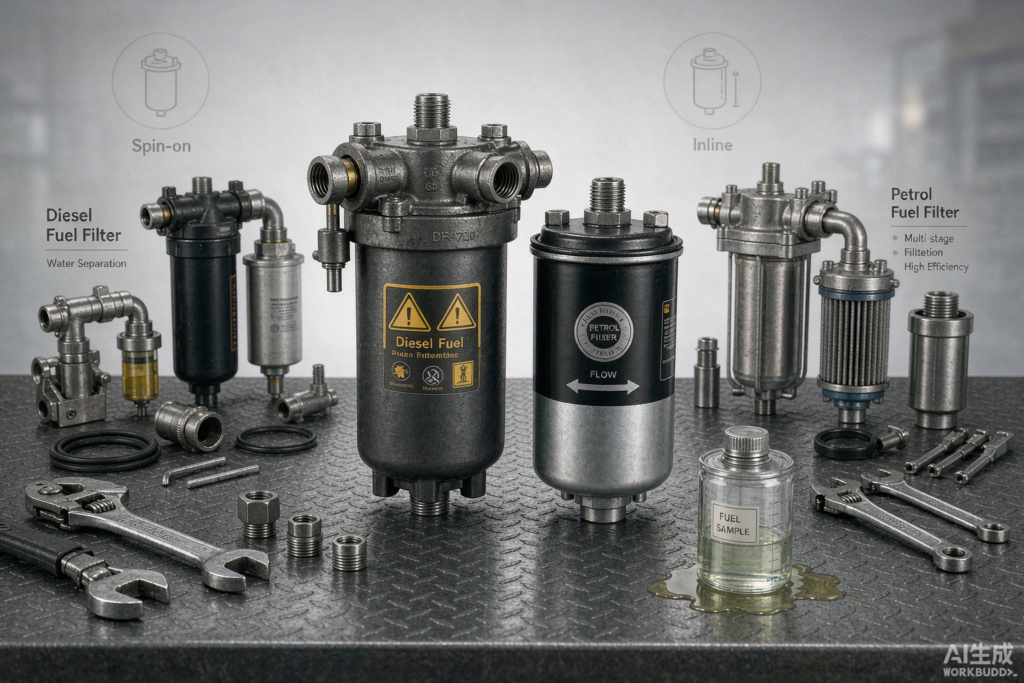
Gasoline vs Diesel Fuel Filters
The two fuels demand different filter designs:
- Gasoline — typically an inline canister or an in-tank strainer with fine mesh. The enemy is particulate contamination.
- Diesel — usually a spin-on or cartridge element plus a water separator. Water — not just dirt — is the real threat, because it rusts injectors and freezes in lines.
Signs Your Fuel Filter Needs Replacement
- Hard or hesitant starting, especially when hot
- Loss of power under load (hill climbs, towing)
- Erratic idle or stalling
- After water contamination in the bowl
- For diesel: frequent water-drain warnings
Recommended Replacement Intervals
| Application | Interval | Notes |
|---|---|---|
| Passenger gasoline | 40,000 km / 3 yrs | Whichever comes first |
| Light diesel (city) | 30,000 km | Drain water monthly |
| Heavy-duty truck | 20,000–40,000 km | Per OEM + duty cycle |
| Ag / off-road | 15,000–25,000 km | Dusty or biodiesel = shorter |
For fleets, base the interval on fuel throughput and duty cycle, not the calendar. See our heavy-duty truck filter guide for fleet TCO detail.
Step-by-Step Replacement (with caveats)
- Relieve fuel pressure (disconnect the pump fuse, run to idle stall).
- Place a catch pan — fuel spills are a fire and slip hazard.
- Swap the element and always fit new seals / O-rings.
- Prime the system (hand primer where fitted).
- Diesel only: bleed air from the lines or the engine will not start (air lock).
Warning: reusing old seals or skipping the bleed step is the most common cause of post-replacement comebacks.
Fuel Filter Cross Reference
The logic is identical to air filters: anchor on the OE number and application, then validate dimensions.
| OE Number | Application | Type | HW Equivalent |
|---|---|---|---|
| 23390-0L010 | Toyota Hilux 2.5 / 3.0 D-4D | Cartridge | HW-FF-610 |
| 8200749580 | Renault 1.5 dCi | Cartridge | HW-FF-715 |
| 0986AF1-0… | VW TDI (Mann equivalent) | Spin-on | HW-FF-820 |
| 1132779… | BMW N47 | Cartridge | HW-FF-925 |
Example numbers — confirm against the manufacturer’s current catalogue before quoting.
Common Mistakes
- Reusing old O-rings (leaks, air ingress).
- Not priming a diesel system (air lock, no start).
- Mixing gasoline and diesel element types.
- Quoting on a competitor code instead of the OE number.
Frequently Asked Questions
How often should a diesel fuel filter be changed?
Every 20,000–40,000 km, and drain the water separator monthly in humid or biodiesel-heavy markets.
Can a clogged fuel filter damage the pump?
Yes. Restriction forces the pump to work harder and can shorten its life.
Are gasoline and diesel fuel filters the same?
No. Diesel elements include water separation and different media grades.
What does a water separator actually do?
It removes free water from diesel before it reaches and rusts the high-pressure injectors.
How do I cross-reference a fuel filter?
Match the OE number and vehicle application, then verify dimensions and seal kit with the manufacturer. Request the fuel filter catalogue and free samples here.